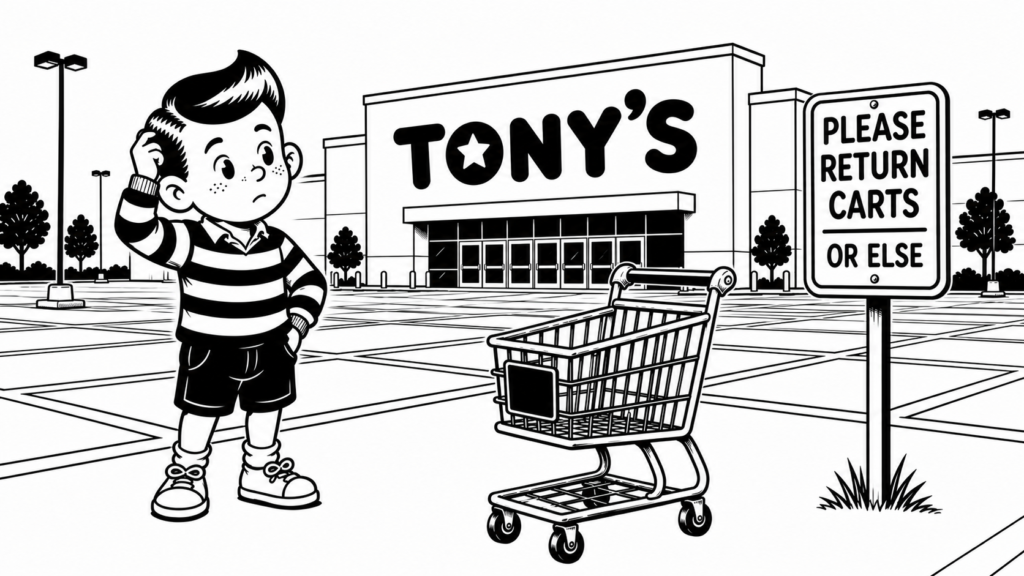
How one simple shopping cart reveals character, responsibility, and everyday values.
Most of my daily interactions outside of work and home happen at the grocery store. It is one of the few places where people from every walk of life cross paths. Families, students, retirees, professionals rushing home after work, and people who seem to have nowhere else to be all share the same aisles. If you pay attention long enough, the grocery store becomes a fascinating study of human nature.
You notice the little things. There is the shopper who parks their cart sideways while comparing two brands of pasta as though they are deciding the future of civilization. Someone else leaves their cart in the middle of the aisle while wandering off in search of another item. Everyone else becomes an unwilling participant in an obstacle course.
Yet nothing catches my attention more than the shopping carts left scattered across the parking lot. Some are abandoned beside empty parking spaces. Others are left balancing on curbs or tucked behind parked cars. On windy days, they become runaway missiles searching for an unsuspecting vehicle. Every time I see one, I cannot help but wonder what went through that person’s mind. Was it laziness? Were they in a hurry? Or did they simply assume someone else would deal with it?
That simple question eventually led me to something called the Shopping Cart Theory. The idea became popular online in 2020 because it proposed something surprisingly profound. Returning a shopping cart is one of the few acts in everyday life that nobody can force you to do. There is usually no reward if you return it and no punishment if you leave it behind. The decision rests entirely with you.
Whether or not you agree with the theory, it does raise an interesting point. Small actions often reveal more about us than the grand gestures we proudly advertise. Character is usually built through ordinary habits that nobody applauds. It is often the smallest choices, not the biggest ones, that reveal who we really are.
Interestingly, some people catch themselves halfway across the parking lot, stop, turn around, and return the cart anyway. Those moments restore a little faith in humanity because they show that people can recognize a small mistake and quietly correct it without anyone asking. We all make mistakes, but not everyone chooses to fix them.
Over the years, I have heard every excuse imaginable. Some people say they are too busy. Others argue that returning carts gives employees less work to do, as if abandoning them somehow protects jobs. Some genuinely have mobility issues, and that is an entirely different situation. But for most of us, returning a cart takes less than a minute.
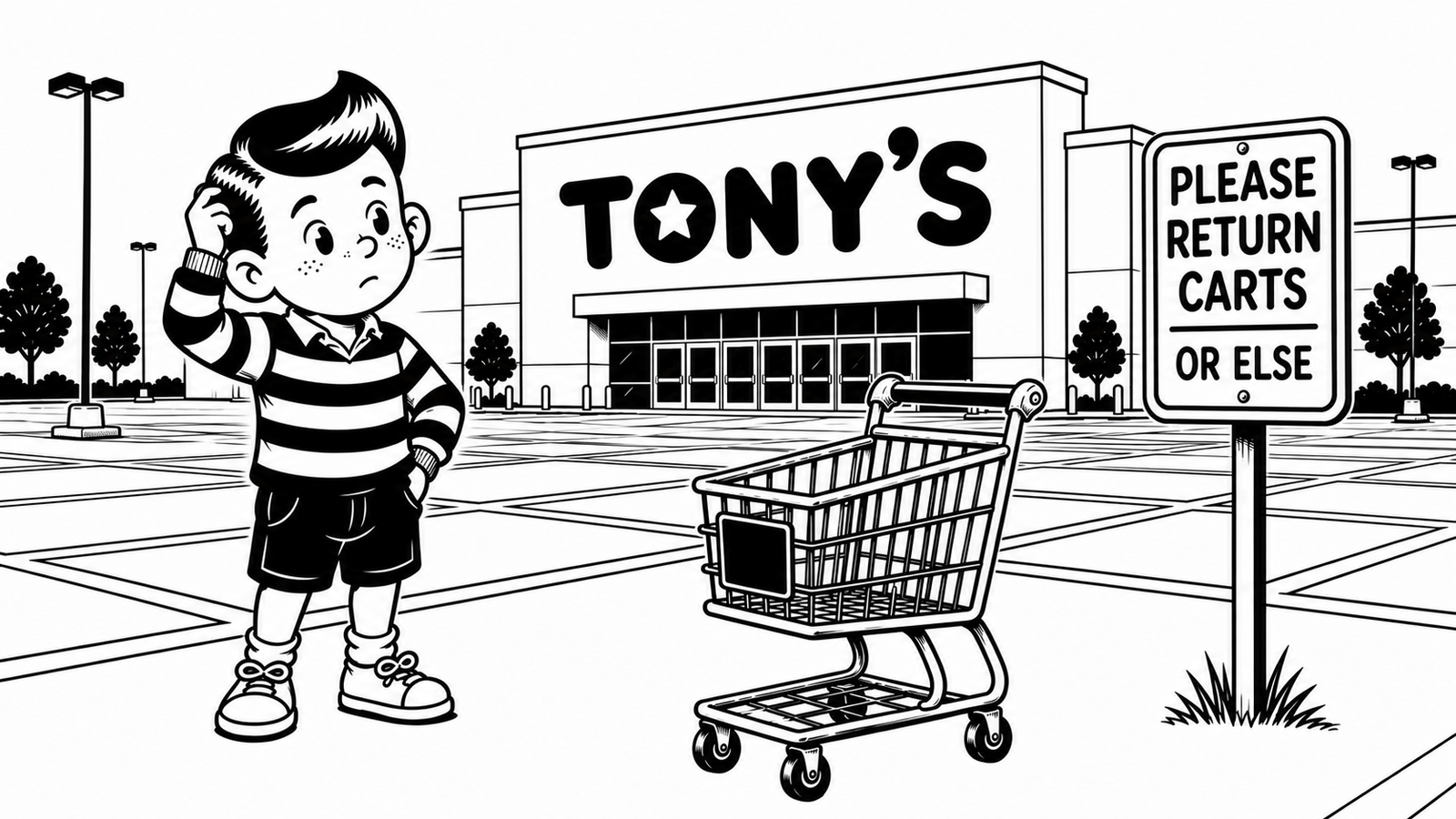
Businesses have tried different ways to encourage better habits. Aldi’s famous quarter deposit is probably the best-known example. You insert a coin to unlock a cart and receive it back only after returning it. It is a remarkably simple system that works because it creates a tiny incentive while reminding shoppers that shared spaces deserve shared responsibility.
The internet has even found a way to turn cart etiquette into entertainment. Channels such as Cart Narcs have built large audiences by confronting shoppers who leave carts behind. The videos are often humorous, occasionally uncomfortable, and sometimes surprisingly revealing. They demonstrate just how differently people react when someone politely questions a decision they assumed nobody would notice.
Psychologists would probably describe much of this as diffusion of responsibility. When enough people are around, it becomes easy to believe someone else will take care of the problem. It is closely related to the bystander effect. In a grocery store parking lot, that “someone else” is the employee collecting carts. In everyday life, it becomes the next person expected to clean up the mess we leave behind.
I have often thought that this principle extends well beyond the grocery store. The workplace is full of shopping cart moments. Not literal carts, of course, but small responsibilities that are easy to ignore because someone else will probably handle them. An unfinished task, a forgotten email, or a problem quietly passed to another department can have the same effect. Strong organizations are built when people take ownership of these small responsibilities instead of assuming they belong to someone else. Leaders set the tone, but culture is ultimately shaped by hundreds of ordinary decisions made when nobody is watching.
That is why the shopping cart has become such an interesting symbol. It is not really about grocery stores. It is about respect. Respect for shared spaces. Respect for other people’s time. Respect for the community we all participate in, whether it is a parking lot, an office, or a neighbourhood.
Returning a shopping cart will never make the evening news, and nobody receives a standing ovation for doing it. Yet these small acts quietly accumulate, making our communities cleaner, safer, and a little more considerate. The next time you finish loading groceries into your car, take the extra thirty seconds to return the cart. Chances are no one will notice, and that is precisely the point.
The choices that define us are rarely the ones made in front of an audience. They are the quiet decisions we make when there is no reward, no applause, and no expectation beyond our own sense of responsibility. Maybe that is why I keep noticing abandoned shopping carts. They are never just shopping carts. They are small reminders that the character of a community is built one ordinary decision at a time.

Tony Medeiros is a Montreal-based writer, publisher, and creator with more than two decades of experience telling stories about food, restaurants, pop culture, entertainment, books, comics, music, history, and the things that make life interesting. He is the creator and publisher of Sandbox World, MTL Resto Rap, and Grubbits. Through his writing and publishing, Tony continues to explore new ideas, share stories, and connect readers with the subjects he finds fascinating.