High school friendships are hard to maintain. Some friends stay with you for decades, some disappear the minute the final bell rings, and some seem to belong to one particular chapter of your life. For me, that friend was Jerry. We were together through practically all of high school, and for four years we had a routine that was so predictable that I can still picture us doing the same thing day after day.
I would go to Jerry’s house in the morning and, instead of heading directly to school like two responsible young men, we would walk over to the local convenience store. The owner had built a little room in the back with three video games, and the kids in the neighbourhood had basically turned it into our unofficial arcade. It wasn’t fancy, but to us it might as well have been Las Vegas. Three video games behind a convenience store was all we needed.
We played those games every morning before school. The problem was that we were having such a good time that we kept forgetting we were actually supposed to be somewhere else. More specifically, we were supposed to be sitting in homeroom. We were almost always late, and we became pretty creative in explaining why.
We had excuses for everything. Sometimes the bus was late. Sometimes there was some mysterious problem that apparently required an explanation. I’m sure the teachers had heard every version of our story by the end of the first year. We kept coming up with new ones anyway. We weren’t particularly good liars, but we seemed to believe that if we told the story with enough confidence, somebody might eventually believe us.
Once school was finished, we would get on the bus and, rather than going home like normal students, head straight back to the convenience store to play some more. Eventually, when we were tired of the games, we would head back to Jerry’s place. I would hang around for a while, then catch my bus home. The next morning, we would do it all over again, and somehow this routine lasted for four years.
There was one thing that made the entire operation possible, and it wasn’t friendship, dedication, or an unusually understanding convenience-store owner. It was quarters. Lots and lots of quarters.
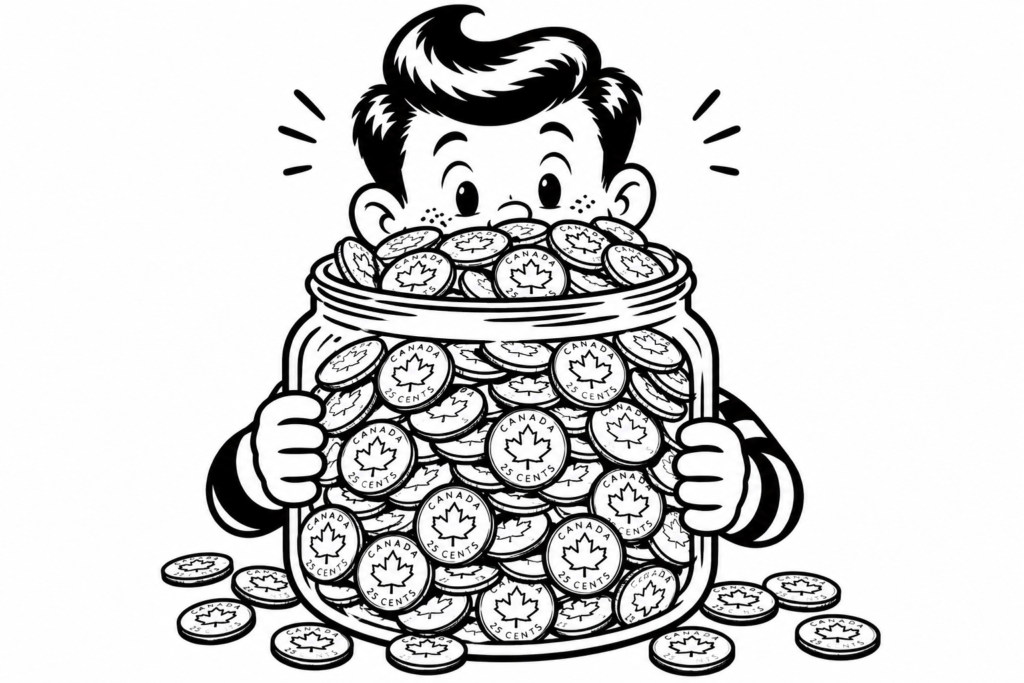
Jerry’s grandmother had died and left him the most incredible jar of quarters I had ever seen. It was a huge glass jar, and as a kid looking at it, I was convinced it was bottomless. Every time we were getting ready to head out, Jerry would go to that jar and dip his hand into it. Out would come a handful of quarters, and off we would go to the arcade.
It was like having our own private bank, except the bank was sitting in Jerry’s house and its entire purpose was financing two teenagers’ video-game addiction. The jar became part of our routine. We didn’t have to think about whether we had enough money to play. Jerry had the jar, the jar had the quarters, and the quarters had video games attached to them. It was a beautiful economic system.
The other kids figured this out too. Whenever friends came over to Jerry’s house, they knew about the jar. If Jerry wasn’t looking, a few quarters might mysteriously disappear into someone’s pocket. I’m not saying the jar was treated like a public treasury, but there were certainly people who seemed to believe they had partial ownership in it.
Jerry’s home life was different from mine. He was living with his father, and his parents were divorced. At the time, most of the kids I knew still had both parents living together, so Jerry’s family situation seemed unusual to me. He was different in other ways too. His room was usually a mess, his dad gave him an allowance, and Jerry spent that money on pretty much whatever he wanted.
That included things I definitely wasn’t telling my mother about. Jerry had a collection of skin magazines, and as a teenager I knew enough to understand that this was not something I wanted coming up in conversation at my house. I never told my mother much about Jerry because she probably wouldn’t have approved of the kid I was spending practically every day with, and I had no intention of giving her additional information.
Jerry had a reputation for finding things that most teenagers probably weren’t supposed to have. One day, he came across something a little more adult than the usual teenage entertainment and decided that keeping it to himself would be a waste. He invited a bunch of kids over to his house to take a look, and somehow word got around. By the time the afternoon rolled around, Jerry’s house was packed. It seemed like half the school had received the invitation, and everyone had suddenly found a reason to make their way over there. Jerry was right in the middle of it all, completely comfortable with the fact that his house had become the unofficial headquarters for teenage curiosity.
Looking back, that was Jerry. He had this strange ability to turn almost anything into an event. Give him a jar full of quarters and we’d end up at the arcade. Give him something he probably shouldn’t have and half the school somehow found out about it. He didn’t necessarily have the most organized life, but somehow he always had something going on.
Jerry also had a habit that eventually drove me a little crazy. He would call me at home almost every day and make me listen to his bootleg recordings of rock bands over the telephone. At first, I thought it was pretty cool. After a while, though, there are only so many muffled bootleg recordings a teenager can listen to through a telephone receiver before he starts wondering if there isn’t something else he could be doing.
I think Jerry just wanted somebody to share those things with. He liked his music, he liked having his friends around and he wanted people to approve of the things he liked. He wasn’t a bad guy. He could just be a bit of a pain in the ass sometimes, and I suppose I probably was too.
Then high school ended. When we went to college, we started moving in different directions. I wanted to keep learning and moving forward, while Jerry didn’t really want to continue with school. Eventually, he fell out of the system altogether, and somewhere along the way we stopped being the two guys who went to the convenience store every morning.
I didn’t think much about Jerry for a long time. High school was over, college had taken me in another direction, and life had a funny way of filling up the spaces where old friendships used to be.
Then, many years later, I ran into Jerry at a Ray Harryhausen film festival, and there he was. He was balder, but otherwise he seemed exactly the same. It was almost like somebody had taken the Jerry I remembered from high school, put him away for a few decades and brought him back out. The funny thing was that Jerry wanted to rekindle the friendship, and as we started talking, I discovered that some things really hadn’t changed.
He was still doing the bootleg recordings. I couldn’t help but laugh at that because, after all those years, Jerry was still the guy who wanted me to listen to recordings of rock bands. It was strangely comforting in a way. The world had changed, we had changed, and yet Jerry had somehow managed to carry that one particular part of himself forward.
But seeing him again also made something very clear to me. I didn’t hate Jerry, and I never had. We had spent four years together, and there were a lot of good memories in those four years. The video games, the excuses for being late, the endless jar of quarters, the strange adventures at his house and all those phone calls with bootleg rock recordings were part of my high school life.
I had simply had four years of Jerry. That might sound harsh, but it wasn’t meant that way. I had outgrown the friendship. We had gone in different directions, and there was no reason to pretend otherwise. Jerry was still Jerry, and I was no longer the person who needed Jerry in my life every day.
Sometimes a friendship doesn’t end because somebody did something terrible. There isn’t always an argument, a betrayal, or some dramatic moment when you decide you’re finished with someone. Sometimes you just grow up and discover that the person who was perfect for one chapter of your life doesn’t necessarily belong in the next one.
I think that’s what happened with Jerry.
And maybe that’s why, all these years later, I can remember Jerry with a smile. I remember the kid with the messy room, the bootleg recordings, the three video games behind the convenience store and that seemingly bottomless jar of quarters. For four years, Jerry was my friend, and when I look back now, I’m glad I had those four years.

Tony Medeiros is a Montreal-based writer, publisher, and creator with more than two decades of experience telling stories about food, restaurants, pop culture, entertainment, books, comics, music, history, and the things that make life interesting. He is the creator and publisher of Sandbox World, MTL Resto Rap, and Grubbits. Through his writing and publishing, Tony continues to explore new ideas, share stories, and connect readers with the subjects he finds fascinating.