Every scraped knee, muddy shirt, and close call reminded me that the greatest childhood freedom also came with risks.
I didn’t need a driver’s license in the 1970s. I had a bicycle.
That bike wasn’t just transportation. It was freedom, independence, and my passport to a world that seemed much bigger than it really was. The moment I pushed off from the driveway, the whole neighborhood opened up in front of me. I’d ride to the corner store, a friend’s house, the park, or sometimes nowhere in particular. Half the fun was having no destination. As long as I was home before supper, life was good.
Looking back, I realize I wasn’t just riding a bicycle. I was riding through whatever world had captured my imagination that week. One day I was a race car driver. Another day I was Evel Knievel. Then, in 1977, I became Luke Skywalker.
Back then, our world wasn’t measured in kilometres. It was measured by how far our legs could take us before we got tired. Empty lots, back alleys, schoolyards, and dirt trails became our highways. Our parents somehow trusted we’d find our way home, even though, once we disappeared around the corner, they had no idea where we were.
Bike culture was everywhere. Riding was only half the experience. The other half was fixing, rebuilding, and customizing your bicycle until it looked like no one else’s. Every neighborhood had that one kid who could take apart almost any bike, scatter the parts across a driveway, and somehow put everything back together before dinner.
The muscle bike ruled the street. Ape-hanger handlebars, a banana seat, and a stick shifter weren’t just accessories. They transformed an ordinary bicycle into whatever your imagination wanted it to be. Whether it actually made you faster didn’t matter. In your mind, you already were.
I’d rummage through neighbourhood garages, sheds, and backyards looking for old bikes or spare parts. We didn’t care if anything matched. If it rolled, it was worth saving. A little spray paint from Dad’s garage, a different set of handlebars, maybe a mirror or a bell, and suddenly you weren’t riding the same bike anymore. You were riding your bike.
Keeping it running was part of growing up. Flat tires weren’t disasters. They were Saturday afternoon repair jobs. Before long, your hands were black with grease, your shirt was filthy, and your bike was ready for another adventure.
Every bike had its own personality, but my favourite upgrade wasn’t bought in a store. I clipped playing cards into the spokes with wooden clothespins so my bicycle sounded like a motorcycle. Then Star Wars arrived, and ordinary playing cards suddenly weren’t good enough. Like millions of kids, I proudly sacrificed brand-new Star Wars trading cards because the thicker cardboard made an even better sound. We weren’t thinking about collectibles. We were thinking about making our bikes sound cooler.
Today those cards are worth far more than they were back then, but I wouldn’t change a thing. Those few pieces of cardboard bought me memories that have lasted almost fifty years.
By 1977, Star Wars had completely taken over my imagination. I wasn’t getting ready to jump a homemade plywood ramp anymore. I was Luke Skywalker climbing into my X-wing, and that ramp wasn’t just a ramp. It was the Death Star. Somewhere beyond it was that tiny, impossible exhaust port, and I had one chance to make the shot.
I pedaled as hard as I could, hit the ramp, and for one glorious second I was flying through the trench run. In my mind, I had just saved the Rebel Alliance.
Then gravity reminded me I was just a kid on a bicycle.
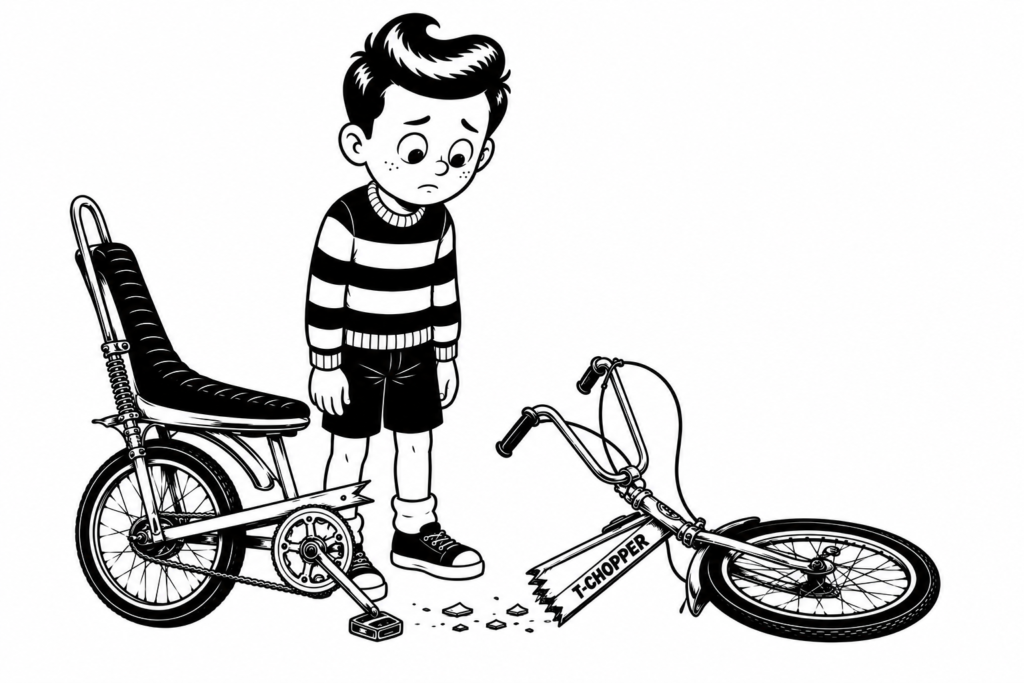
I came crashing back to Earth, and my bike snapped clean in half. I landed flat on my back, staring at the sky. The only Skywalker I did that day was lie there wondering what had happened before picking myself up and walking home without a bicycle.
Looking back, I guess my welding skills weren’t much better than the engineers who built the Death Star. They couldn’t keep their space station together, and apparently I couldn’t keep my bicycle together either.
That crash didn’t slow me down for long. I loved speed a little too much. Stop signs became suggestions, yellow lights meant pedal faster, and more than once I heard tires screech while my heart jumped into my throat. I’d promise myself to be more careful, but those promises usually lasted until the next ride.
Rain wasn’t a reason to stay inside. It was another adventure. We’d charge through puddles, race along muddy trails, and come home with the backs of our T-shirts covered in dirt thrown up by the rear tire. Those muddy streaks were my badge of honour. My mother saw extra laundry. I saw proof that I’d squeezed every bit of fun out of the day.
Looking back now, it’s amazing any of us survived. Helmets were rare, elbow pads didn’t exist in our world, and showing off usually won the argument over common sense. My generation was turned loose with one instruction: “Be home for supper.” That was the entire plan.
Most of us made it home every night, but not everyone did. One of my friends was hit by a car and missed an entire year of school while he recovered. That memory never left me. It reminds me that all the freedom we enjoyed came with risks we were far too young to understand.
That’s one reason I understand today’s parents. They’re not trying to take childhood away. They’re trying to make sure their children come home safely so they can have memories of their own.
Today I see people riding fat-tire bicycles, and I have to admit they look like fun. Then I picture myself bouncing down the street looking like Pee-wee Herman, and the feeling passes pretty quickly. Besides, I’d rather spend the money on gasoline.
I don’t really miss the bicycle itself. I miss what it gave me. It taught me independence before I was old enough to drive. It taught me to fix things instead of throwing them away. Most of all, it gave me the confidence to explore the world one street at a time.
Every time I see a banana seat, a pair of ape-hanger handlebars, or hear the unmistakable rattle of a playing card in bicycle spokes, I’m twelve years old again. For a few seconds, the neighborhood is waiting, the sun is shining, and there’s nowhere I have to be except wherever my bike decides to take me.
We didn’t know we were making memories. We thought we were just having another Saturday.
Tony Medeiros is a Montreal-based writer, publisher, and creator with more than two decades of experience telling stories about food, restaurants, pop culture, entertainment, books, comics, music, history, and the things that make life interesting. He is the creator and publisher of Sandbox World, MTL Resto Rap, and Grubbits. Through his writing and publishing, Tony continues to explore new ideas, share stories, and connect readers with the subjects he finds fascinating.