This happened during my second year of college, when I had a radio show at the school. This was also the year I was going through my Beatnik stage. I was into poetry, music and anything that made me feel like I should be sitting in a coffee shop discussing philosophy while pretending I understood it. I even bought myself a pair of moccasins, which seemed like a very good idea at the time. Have you ever tried walking around on concrete in moccasins? Step on a pebble or a little rock and you quickly discover that there isn’t much between your foot and the ground. It hurts. A lot. Unfortunately, I did a lot of walking around campus.
I was really into collecting old records. Every week, I would bring a stack of about 20 records from home and carry them with me to college. I didn’t just take them to the radio station either. I carried them around with me to all my classes. Students would see me walking down the halls with this stack of records and ask what I was going to play on the air that day. I guess I had accidentally become the guy with the soundtrack. These weren’t exactly disposable albums. This was my collection, and I treated those records like they were carrying the national archives.
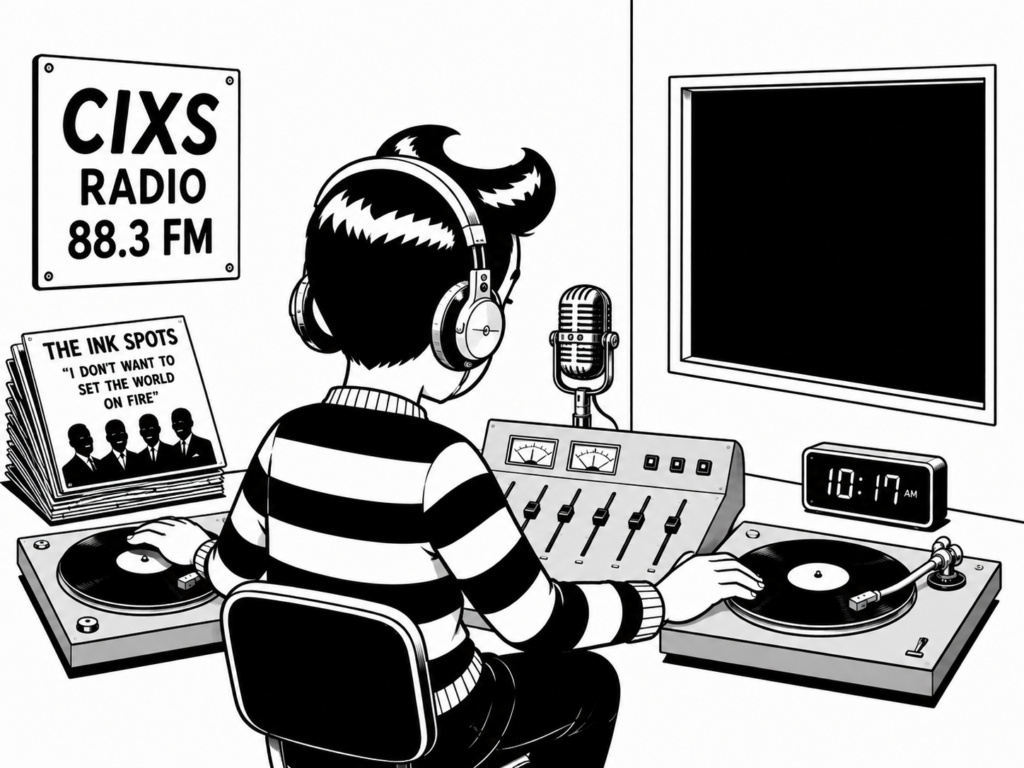
Looking back, there was another little musical warning sign that I probably should have paid attention to. I was into The Ink Spots, and that day “I Don’t Want to Set the World on Fire” was sitting in my playlist. I was actually cueing the record up, getting it ready to play on the show. I had no idea that the phrase set the world on fire was about to take on a very different meaning. Sometimes life gives you a warning and you don’t recognize it until much later. This was definitely one of those times.
The radio station itself was pretty basic. In front of me was the production room, although we had given it another name. We called it the reproduction room. Why? Because the DJs would occasionally bring their girlfriends in, turn off the lights and conduct their own private programming. The room was pitch black when the lights were off, and the walls were soundproofed with egg cartons, which probably wasn’t exactly the latest word in acoustic engineering.
We had an unspoken code. If the lights in the reproduction room were off, shenanigans were taking place. There was also a very good chance that nobody in there could hear anything happening in the outside world. They were quite literally in their own little universe. This would become important later.
The school had given all the DJs very specific instructions. If the emergency alarm went off while you were on the air, the DJ was responsible for telling the school to evacuate the premises calmly, respectfully and safely. It was one of those instructions you hoped you would never have to use. If the alarm sounded, you got on the microphone and told everyone to leave.
So, naturally, about fifteen minutes into my show, the alarm went off.
I stopped spinning records and went straight into emergency mode. I got on the air and told everyone to evacuate the building. People started leaving, and suddenly what had been an ordinary college day turned into an evacuation. Students were heading for the exits, staff were trying to figure out what was happening, and management was probably wondering why the radio station had suddenly become the voice of authority.
After the evacuation, I ran into the college radio manager. He had the kind of look on his face that suggested he was trying to figure out what had just happened. The funny thing was, I was probably just as confused as he was. Then he mentioned the alarm clock, which was news to me. I had been sitting at that radio table surrounded by my records and two turntables, and I had never even noticed there was an alarm clock sitting there. Apparently, it had been there all along. To think of it, who has a working alarm clock sitting beside the turntables when you’re on the air?
Apparently, we did. I had heard the alarm, assumed it was the emergency alarm we had been warned about, and did exactly what I had been told to do. That’s when it finally hit me. I hadn’t discovered an emergency. I had discovered an alarm clock. Somehow, I had managed to turn the two into the same thing.
Meanwhile, somewhere behind those egg-carton-covered walls, the reproduction room was still operating in its own little universe. The people inside had absolutely no idea that an entire college had just been evacuated. They were carrying on with their afternoon while the rest of the school was emptying out around them.
The room’s unofficial name would eventually become even more appropriate. One of the girls who had been in there that day later became pregnant, so apparently the reproduction room had been living up to its name rather more literally than anyone expected. And then, incredibly, the production room actually caught fire. At that point, the whole thing was starting to sound less like college radio and more like an episode of The Twilight Zone.
When the people inside finally emerged, they must have thought they had stepped into another dimension. The hallways were empty, the classrooms were empty, and the whole school seemed to have been abandoned. They were the last survivors, wandering through a building that had only moments earlier been filled with students and noise. They probably wondered what the hell had happened, but I certainly wasn’t around to explain it.
By that point, I had gathered up my twenty records and decided there was absolutely nothing left for me to do at the college. I grabbed my collection, put on my painful Beatnik moccasins and disappeared as quickly as I could. I wasn’t sticking around for management to discover that the emergency they’d been trying to understand had been caused by the guy in the radio station who was supposed to be playing records.
As far as anyone knew, the last DJ on the air had simply vanished into thin air. Sitting there on the turntable was The Ink Spots, patiently waiting to tell the world that I didn’t want to set the world on fire. Unfortunately, the alarm clock had already beaten me to it.

Tony Medeiros is a Montreal-based writer, publisher, and creator with more than two decades of experience telling stories about food, restaurants, pop culture, entertainment, books, comics, music, history, and the things that make life interesting. He is the creator and publisher of Sandbox World, MTL Resto Rap, and Grubbits. Through his writing and publishing, Tony continues to explore new ideas, share stories, and connect readers with the subjects he finds fascinating.